Stay aware
The ear canal remains open so customers can hear more of the environment around calls and music.
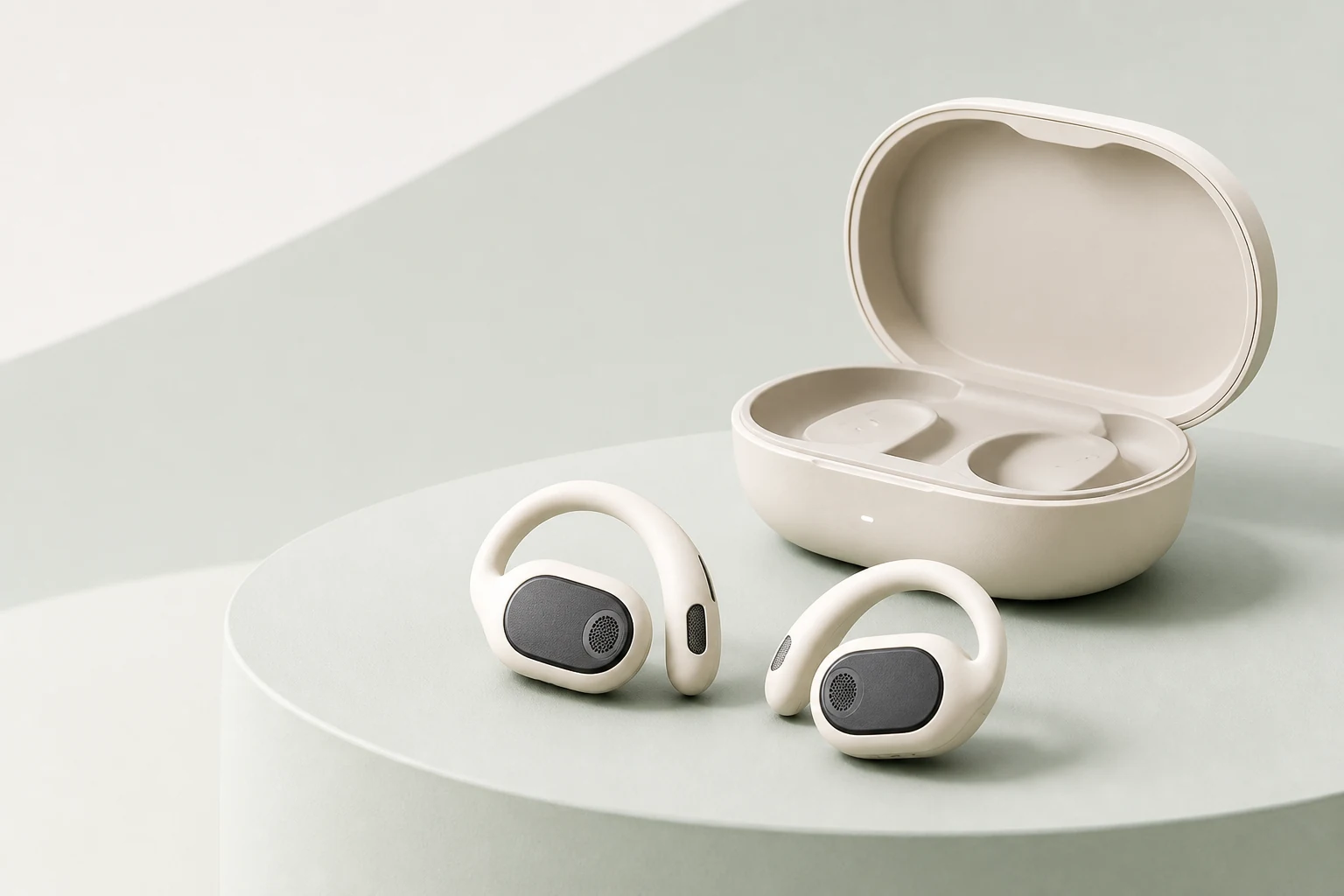
Build an open ear headphones line around secure comfort, environmental awareness and controlled sound direction. Compare air-conduction platforms, ear-hook geometry, call tuning, battery targets and private-label packaging before approving a production sample.
US desktop database · Commercial product intent
The US SERP combines category pages, comparison guides and questions about comfort, awareness and leakage. A useful product page must explain the physical format as clearly as the electronics.
The ear canal remains open so customers can hear more of the environment around calls and music.
Geometry, clamping force and weight distribution matter more than a generic comfort badge.
Speaker position and acoustic tuning should balance clarity with practical leakage control.

Open-ear is especially relevant for running, commuting, field work and shared spaces. Approve the fit while walking and moving—not only while seated—and test prompts, wind behavior and call pickup outdoors.
These are sourcing targets, not universal specifications. Lock final values, certificates and claim language to the approved production-intent sample.
| Acoustic format | Air-conduction open-ear platform |
|---|---|
| Driver target | 14–16 mm class, model dependent |
| Wireless platform | Bluetooth 5.3 / 5.4-class options |
| Runtime target | 8–10 hours; confirm test conditions |
| Protection target | IPX5-class options for active use |
| Call architecture | Dual-mic / ENC-capable options |
| Controls | Physical or touch control map |
| Customization | Color, logo, case, pack and manual |
Segment by customer job, then select electronics, firmware and packaging. Avoid relabeling one undifferentiated specification across every channel.
Secure hook, sweat-resistance target and outdoor controls.
Light pressure, call tuning and optional multipoint planning.
Balanced sound, compact case and broad device compatibility.
Keep the product story, test evidence and packaging language synchronized as the program moves toward production.
Market, channel, target price, quantity and measurable priorities.
Choose a platform, test fit and behavior, then record changes.
Approve color, logo, prompts, packaging, labels and claims.
Lock the golden sample, inspection points and shipment plan.
Visible answers match the structured FAQ data and keep model-dependent language explicit.
Open ear headphones play audio from a speaker positioned near, rather than sealing inside, the ear canal. Ear-hook models normally use directed air conduction and keep more environmental sound available.
No. Both can leave the ear canal open, but many open-ear products use air conduction from a small speaker near the ear. Bone-conduction models transmit vibration through contact with the skull.
Some leakage is possible, especially at high volume in a quiet room. Speaker direction, distance from the ear, fit and volume all affect it, so leakage should be tested on the selected sample.
Use different ear sizes and test walking, running, glasses, head movement and one-hour comfort. Record pressure points, acoustic-position changes and control accessibility.
Typical options include housing and case color, logo method, prompts, control mapping, packaging, inserts, manuals, labels and master-carton marks. Availability and MOQ depend on the selected platform.
Share your market, quantity, target price, feature priorities, branding and packaging scope. The form prepares a WhatsApp inquiry for your review—it does not send automatically.
contact@globalvibecart.com
WhatsApp: +86 172 7868 9106
Planning references: Bluetooth SIG specifications, FCC equipment-authorization resources, and European Commission CE-marking guidance.
These references provide planning context; they do not prove that a particular model is certified or compliant. Verify the applicant, manufacturer, model, configuration, standard, date and market scope of each record.
Last reviewed: 26 July 2026. See About, our method, terms, or contact us.